

Why Is Running a Search in One System Important?
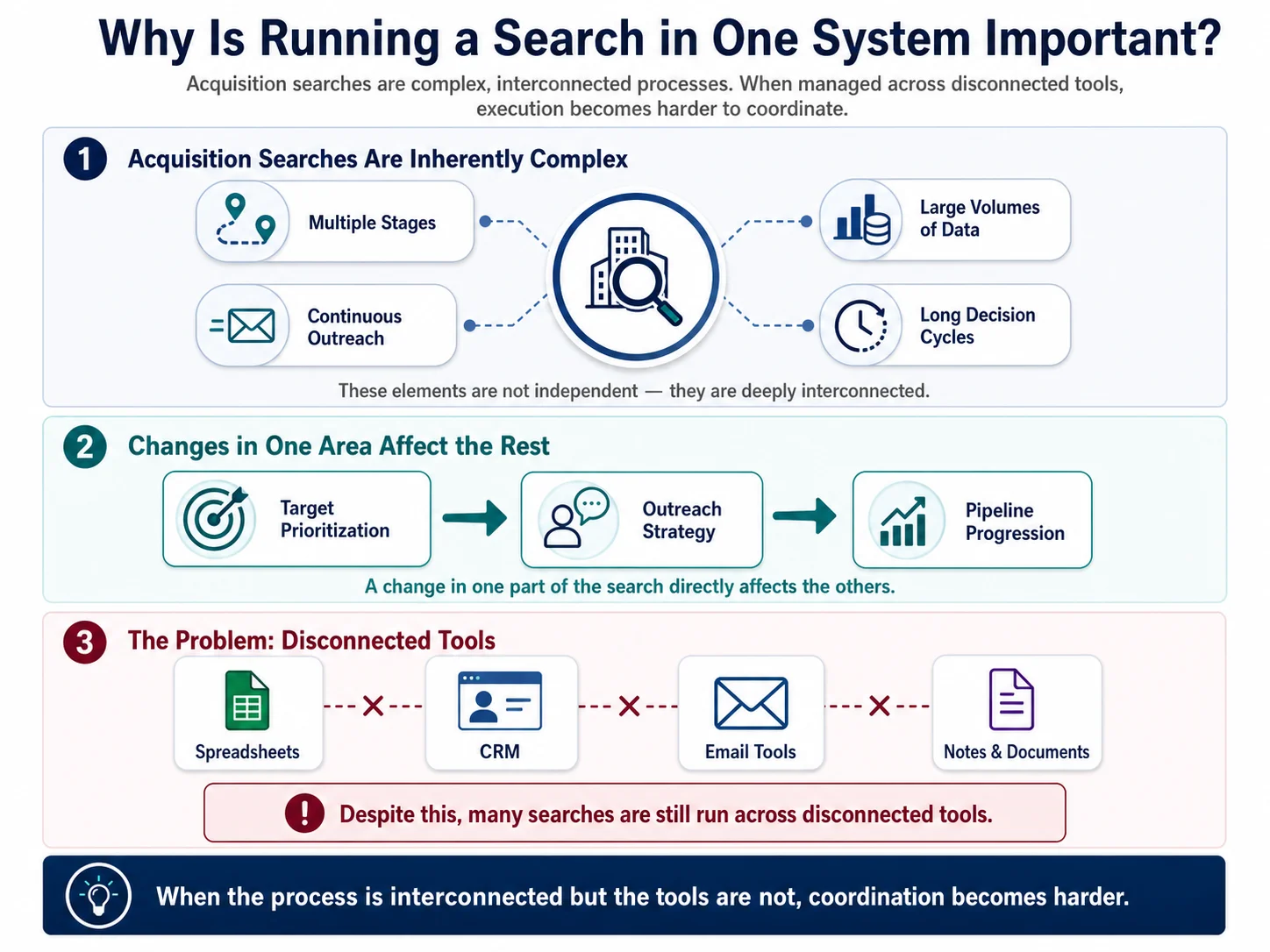
Acquisition searches are inherently complex. They involve multiple stages, large volumes of data, continuous outreach, and long decision cycles. More importantly, these elements are not independent, they are deeply interconnected.
A change in one part of the process (e.g., target prioritization) directly affects others (e.g., outreach strategy, pipeline progression).
Despite this, many searches are still run across disconnected tools.
The Problem with Fragmented Workflows
In practice, searchers often rely on a combination of tools:
- Spreadsheets for sourcing and initial lists
- CRMs for pipeline tracking
- Email tools for outreach
- Notes and documents scattered across different platforms
Individually, these tools can work well. The issue arises in how they interact, or more accurately, how they don’t.
This fragmentation creates a set of recurring problems:
- Information gets lost or duplicated across systems
- Follow-ups are missed or delayed
- Context is fragmented, making it harder to evaluate opportunities holistically
- Time is spent managing tools instead of progressing the search
Over time, the process becomes harder to control and more difficult to scale.
Lack of Coordination Across the Process
When systems are disconnected, coordination becomes a manual effort.
Searchers need to:
- Transfer data between tools
- Update multiple systems separately
- Reconcile inconsistencies across datasets
This introduces friction at every step.
As the number of targets and interactions increases, small inefficiencies begin to compound:
- Data becomes outdated or misaligned
- Pipeline visibility decreases
- Decision-making slows down due to incomplete information
The result is not just inconvenience, but reduced execution quality.
A Unified Operating System
Search Fund Plus approaches this differently by bringing the entire search process into a single environment.
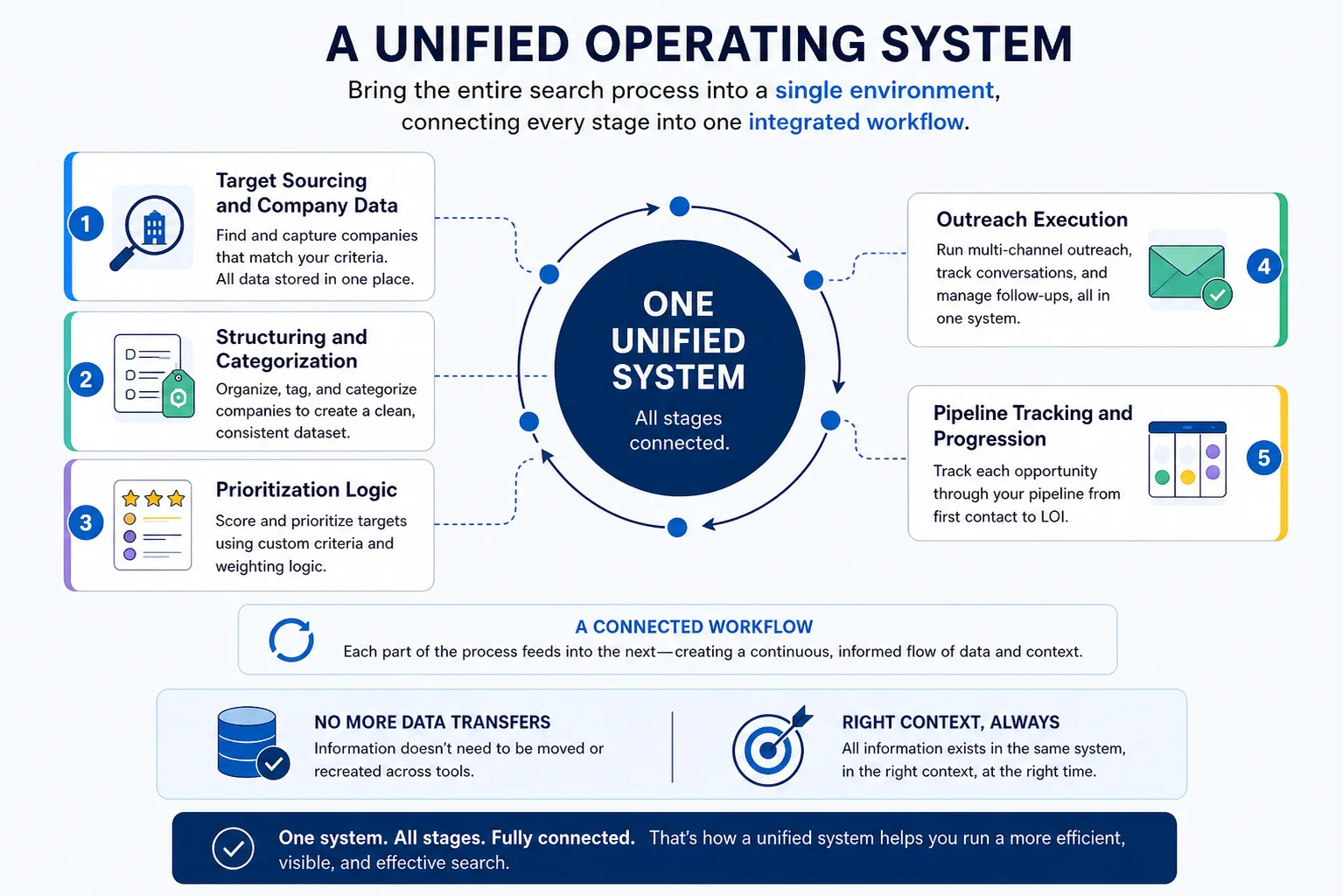
Instead of separating functions across tools, it integrates:
- Target sourcing and company data
- Structuring and categorization
- Prioritization logic
- Outreach execution
- Pipeline tracking and progression
This creates a connected workflow, where each part of the process feeds into the next.
Information does not need to be transferred or reconstructed, it already exists within the same system, in the right context.
Improved Visibility and Control
When all activity happens within one system, visibility improves significantly.
Searchers can:
- Track sourcing, outreach, and pipeline activity in real time
- Maintain consistent follow-ups without relying on memory or external tracking
- Understand where each opportunity stands at any moment
- See how the pipeline evolves over time
This level of visibility makes the process more predictable and easier to manage.
It also enables faster, more informed decision-making because the full context is always accessible.
Reduced Operational Friction
A unified system removes many of the small, repetitive tasks that slow down execution.
Instead of managing tools, searchers can focus on the search itself.
Key reductions include:
- Less manual data transfer between platforms
- Fewer context switches between tools
- Fewer inconsistencies across datasets
- Less time spent on operational coordination
This does not just improve efficiency, it improves consistency, which is critical in long-cycle processes like acquisition search.
From Fragmentation to a Structured Search Process
Running a search in one system is not just about convenience, it fundamentally changes how the process operates.
By bringing all components together into a single, coordinated environment, Search Fund Plus enables a more structured way of working.
This leads to:
- Better visibility across the entire pipeline
- Stronger coordination between sourcing, outreach, and tracking
- More consistent execution over time
- Reduced operational overhead
As a result, the search becomes easier to manage, easier to scale, and less dependent on manual coordination.
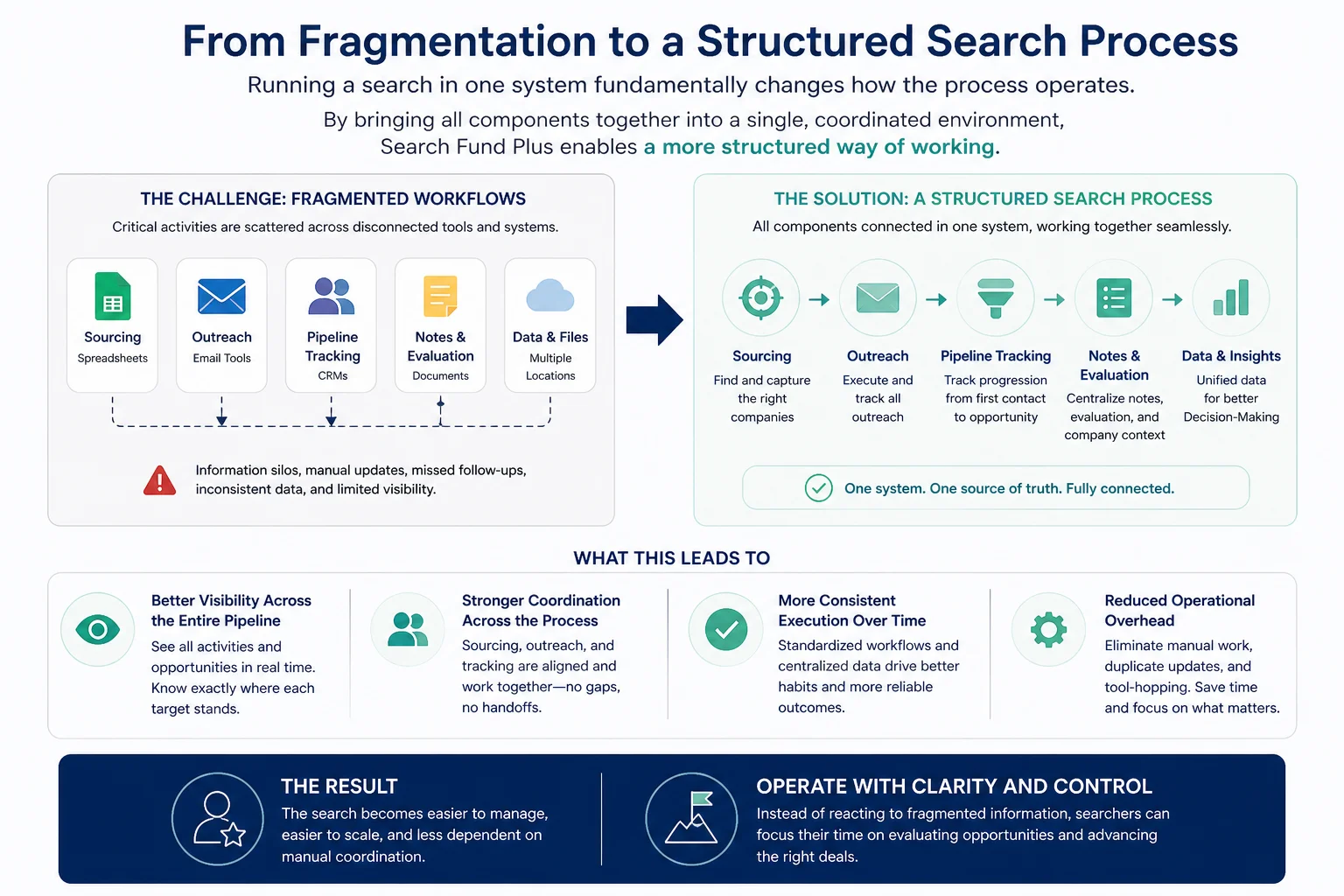
Instead of reacting to fragmented information, searchers can operate with clarity and control, focusing their time on evaluating opportunities and advancing the right deals.