

How Is Search Fund Plus Different from a Traditional CRM?
At first glance, acquisition search can look similar to a sales process. Both involve pipelines, outreach, and ongoing communication. As a result, many searchers initially turn to traditional CRMs to manage their workflow.
However, this similarity is mostly surface-level.
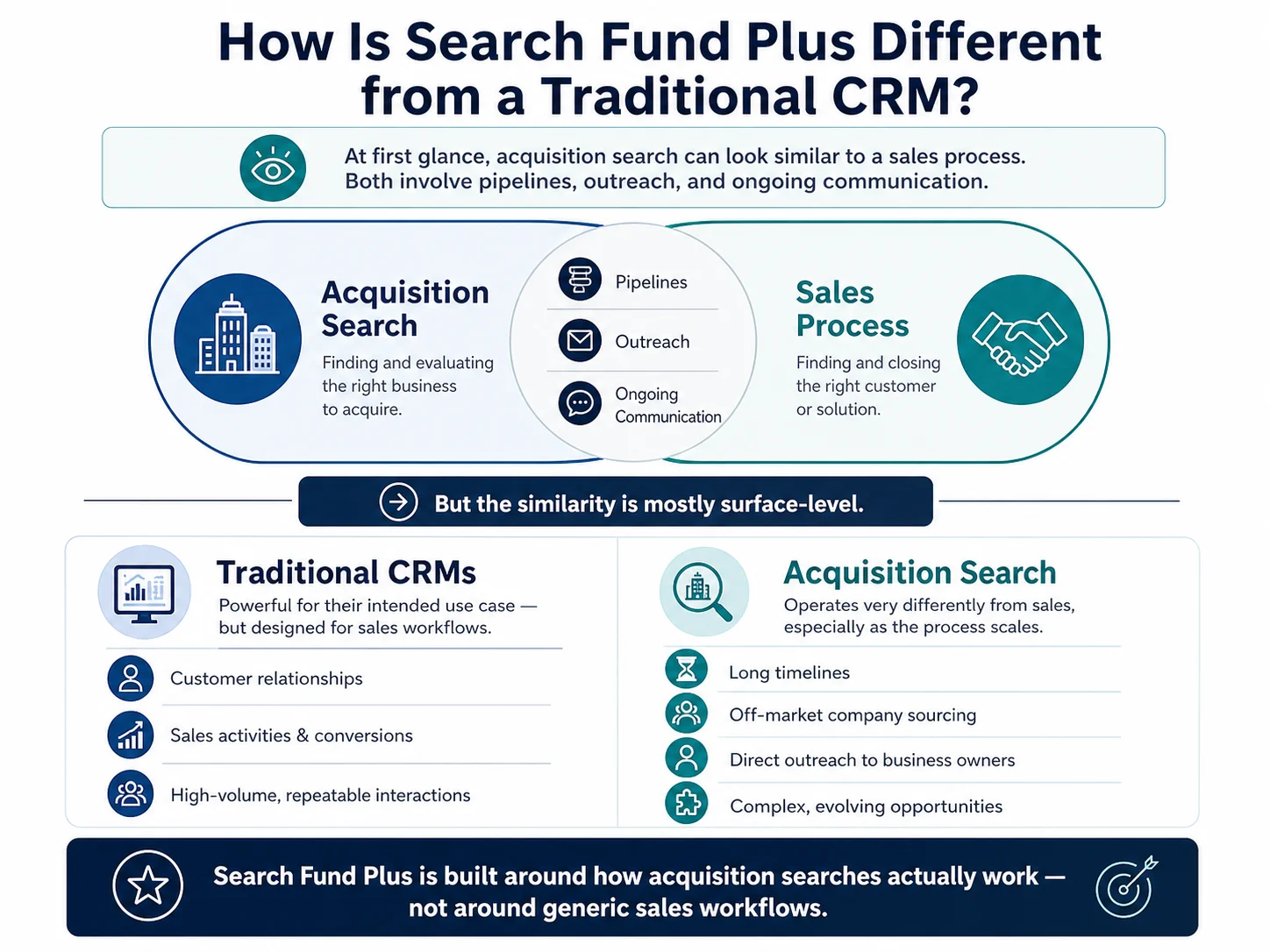
In reality, acquisition search operates very differently from sales, and these differences become more visible as the process scales. Traditional CRMs, while powerful in their intended use case, are not designed for how acquisition searches actually work.
CRMs Are Built for Sales, Not Acquisition
Traditional CRMs are designed around sales workflows. Their core purpose is to help teams manage customer relationships and move deals through relatively structured, short-cycle pipelines.
They are optimized for:
- Managing customers and accounts
- Tracking sales activities and conversions
- Handling high-volume, repeatable interactions
Acquisition search, on the other hand, has a very different structure.
It involves:
- Long timelines with uncertain outcomes
- Off-market company sourcing
- Direct outreach to business owners
- Evolving search criteria and strategy
- Fewer, but significantly more complex opportunities
These differences create a mismatch.
While CRMs can be adapted to support parts of the process, they do not naturally align with how acquisition workflows are structured.
Purpose-Built for Acquisition Search
Search Fund Plus is designed specifically for acquisition search from the ground up.
Instead of adapting a sales tool, it builds the workflow around how searches actually operate.
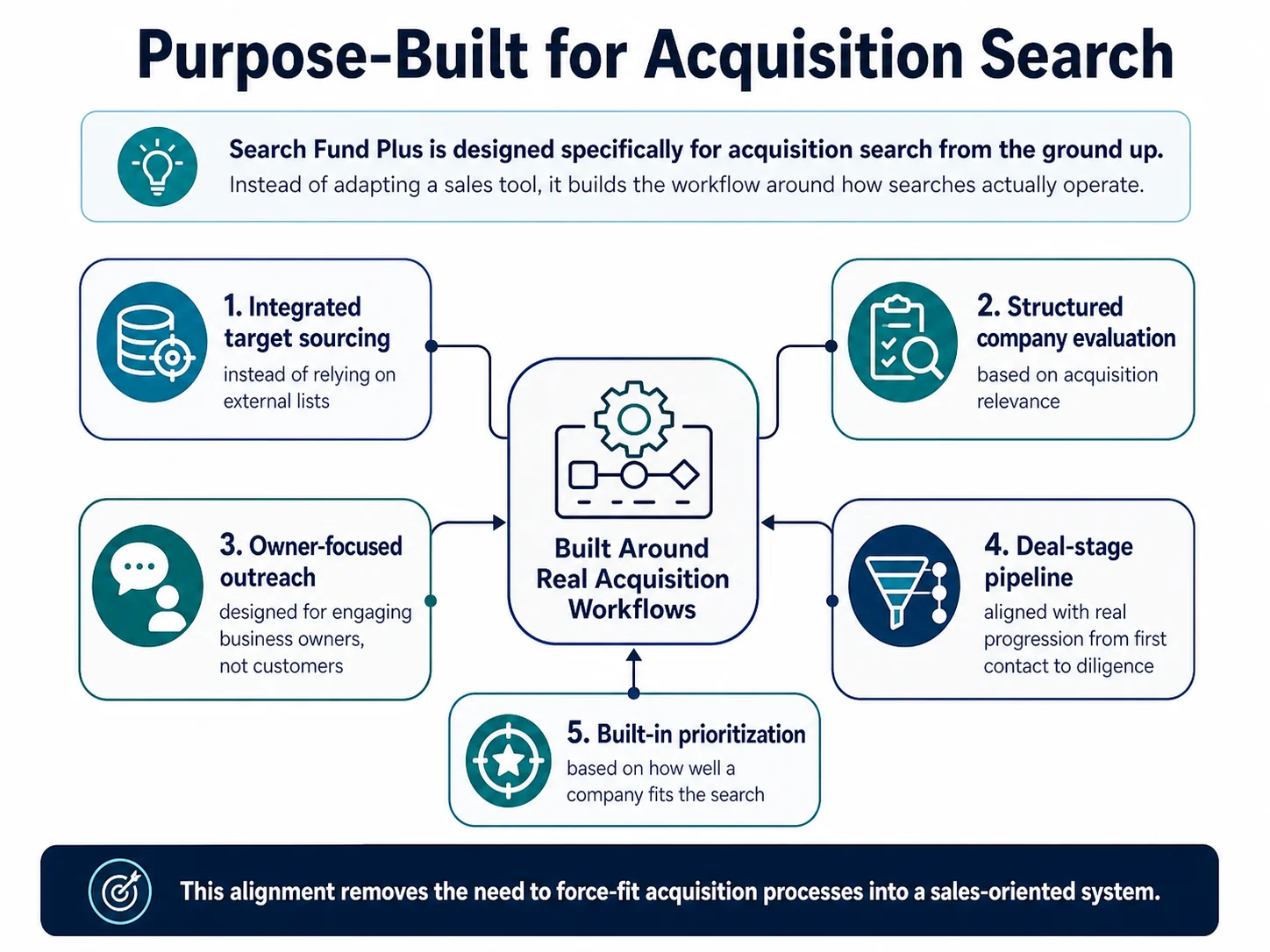
This includes:
- Integrated target sourcing, rather than relying on external lists
- Structured company evaluation based on acquisition relevance
- Outreach designed for engaging business owners, not customers
- Pipeline stages aligned with real deal progression (from first contact to diligence)
- Built-in prioritization based on how well a company fits the search
This alignment removes the need to force-fit acquisition processes into a sales-oriented system.
Acquisition Fit vs. Lead Tracking
One of the most important differences is how opportunities are treated.
In a CRM, leads are generally treated as entries to be managed and progressed. While they may be scored, they are often handled within relatively uniform pipelines.
In acquisition search, not all companies are equal.
Search Fund Plus reflects this by:
- Evaluating companies based on how closely they match the search direction
- Applying the Acquisition Fit Score™ (AFS) to support prioritization
- Structuring pipelines based on relevance, not just activity
This creates a more selective and focused workflow.
Instead of managing a large number of similar leads, searchers work with a prioritized set of opportunities, where attention is intentionally directed toward the highest-fit targets.
Integrated System vs. Layered Tool Stack
Another key difference lies in how the system is structured.
Traditional CRMs typically operate as one part of a broader tool stack. To run a full search, additional tools are often required for:
- Company sourcing and data collection
- Contact discovery
- Outreach automation
- Data structuring and filtering
This creates a layered workflow where information needs to be transferred and coordinated across systems.
Search Fund Plus takes a different approach by integrating these functions into a single environment.
Sourcing, structuring, prioritization, outreach, and pipeline tracking are all connected within the same system.
This reduces:
- Manual data transfer
- Fragmentation across tools
- Inconsistencies in information
And improves overall coordination across the process.
Built for Long-Cycle, Low-Volume, High-Complexity Processes
Sales pipelines are typically designed for shorter cycles and higher volumes.
Acquisition search operates in the opposite direction:
- Fewer opportunities
- Longer timelines
- Higher complexity per deal
Search Fund Plus is built with this structure in mind.
It supports:
- Long-term pipeline visibility across months or years
- Multi-stage deal progression (from outreach to diligence)
- Consistent follow-up across extended timelines
- Tracking of deeper, relationship-driven interactions
This makes it more suitable for managing the type of opportunities that define acquisition search.
From Adapted CRM to Purpose-Built Search Infrastructure
Search Fund Plus is not a CRM that has been adapted for acquisition use cases.
It is a platform designed around the actual mechanics of running a search.
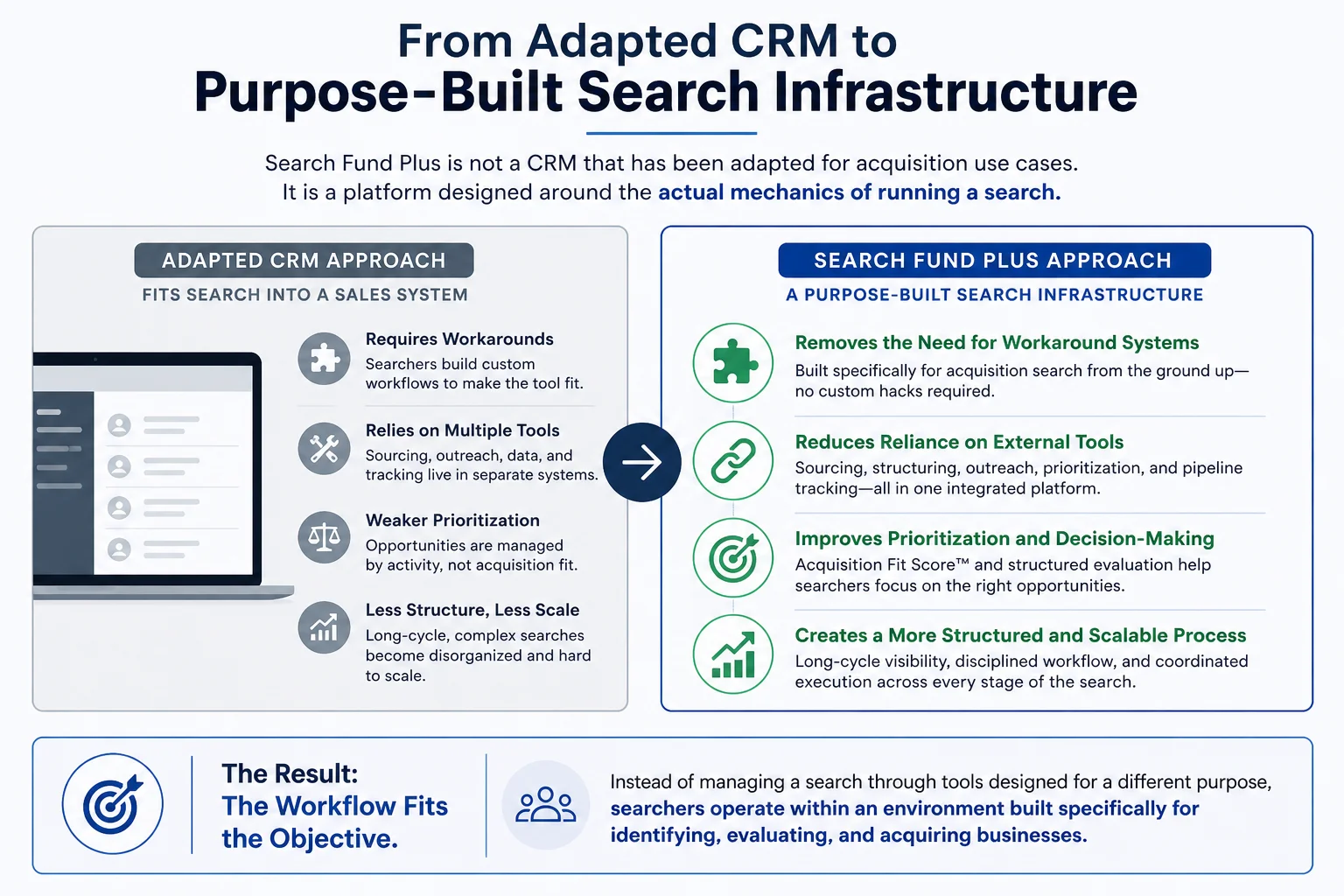
By aligning with how acquisition workflows function, it:
- Removes the need for workaround systems
- Reduces reliance on external tools
- Improves prioritization and decision-making
- Creates a more structured and scalable process
The result is a system where the workflow fits the objective, not the other way around.
Instead of managing a search through tools designed for a different purpose, searchers operate within an environment built specifically for identifying, evaluating, and acquiring businesses.