

What Does “AI-Driven Search Platform” Mean in Practice?
The term “AI-driven” is widely used, but often loosely defined.
In many cases, it refers to isolated features or surface-level automation that does not meaningfully change how work gets done. In acquisition search, however, the value of AI is not in the label itself, but in whether it improves execution across a complex, multi-step process.
Search Fund Plus approaches AI from this perspective.
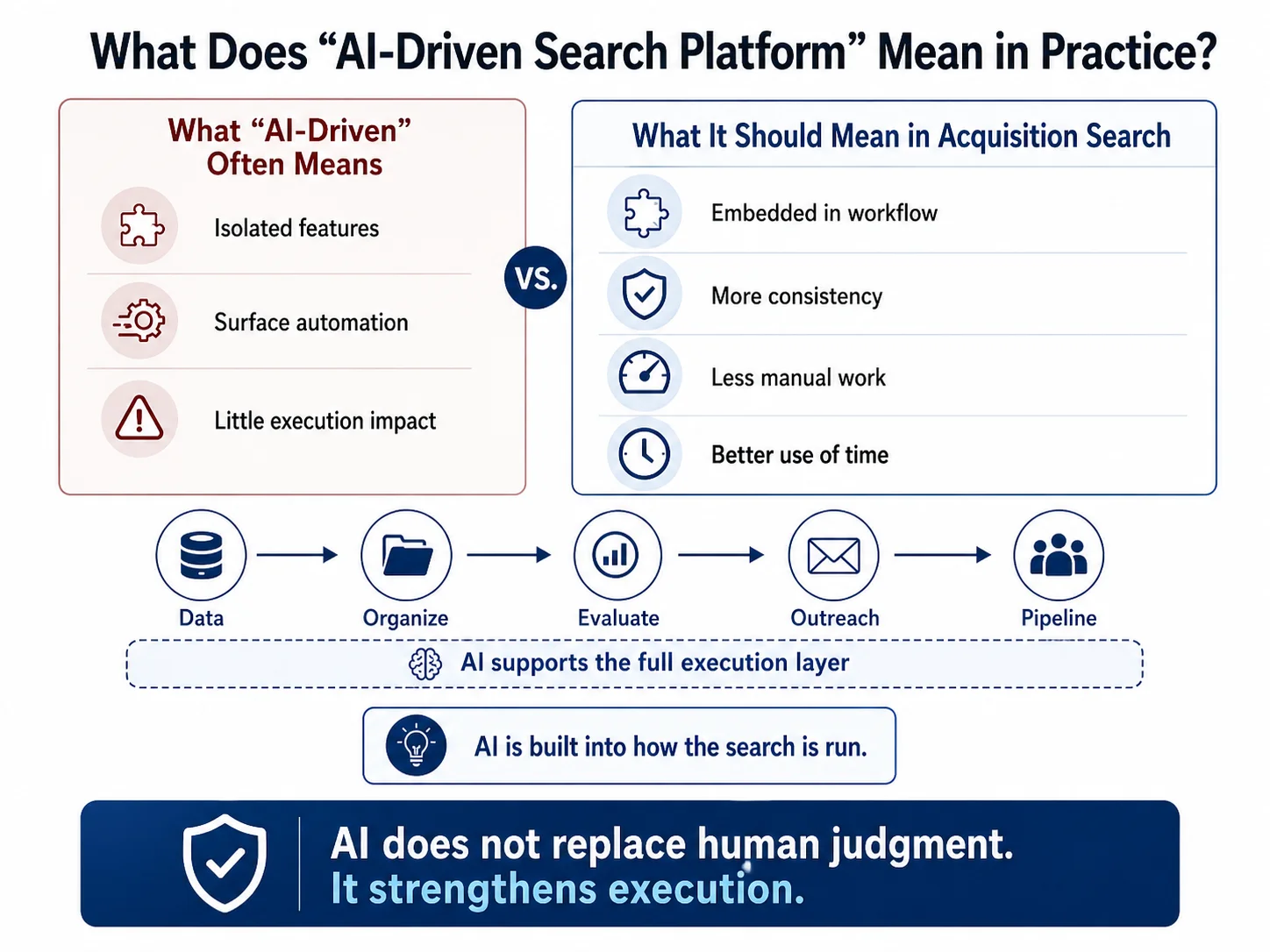
AI is not positioned as a separate tool or standalone capability. Instead, it is embedded within the workflow to support how the search is actually run, improving consistency, reducing manual workload, and enabling better use of time.
The focus is not on replacing human judgment, but on strengthening the underlying execution layer that the search depends on.
AI as an Execution Layer
In Search Fund Plus, AI operates as part of the infrastructure behind the search process.
Rather than being applied at a single point, it supports multiple stages simultaneously, including:
- Structuring and organizing company data
- Categorizing and tagging targets
- Supporting outreach messaging
- Tracking and managing pipeline activity
This integrated approach is important.
Acquisition search is not a single task, it is a sequence of interconnected activities. AI adds value when it helps connect and streamline these activities, rather than optimizing them in isolation.
Its role is to:
- Reduce repetitive manual work
- Improve consistency across processes
- Support decision-making with better-structured inputs
At every stage, the searcher remains the decision-maker, while AI improves how the process is executed.
Improving Data Quality and Structure
One of the most time-intensive aspects of deal sourcing is handling large volumes of fragmented data.
Company information often comes from multiple sources, with varying levels of completeness, formatting, and accuracy. This creates friction early in the process, before any real evaluation can begin.
AI helps address this by:
- Organizing large datasets into structured formats
- Standardizing company information across sources
- Supporting consistent categorization and tagging
This reduces the need for manual cleaning and alignment, which is often one of the most repetitive and error-prone parts of sourcing.
The result is a dataset that is:
- Easier to navigate
- More consistent across entries
- More reliable for downstream decision-making
Supporting Target Prioritization
As the number of potential targets increases, prioritization becomes a central challenge.
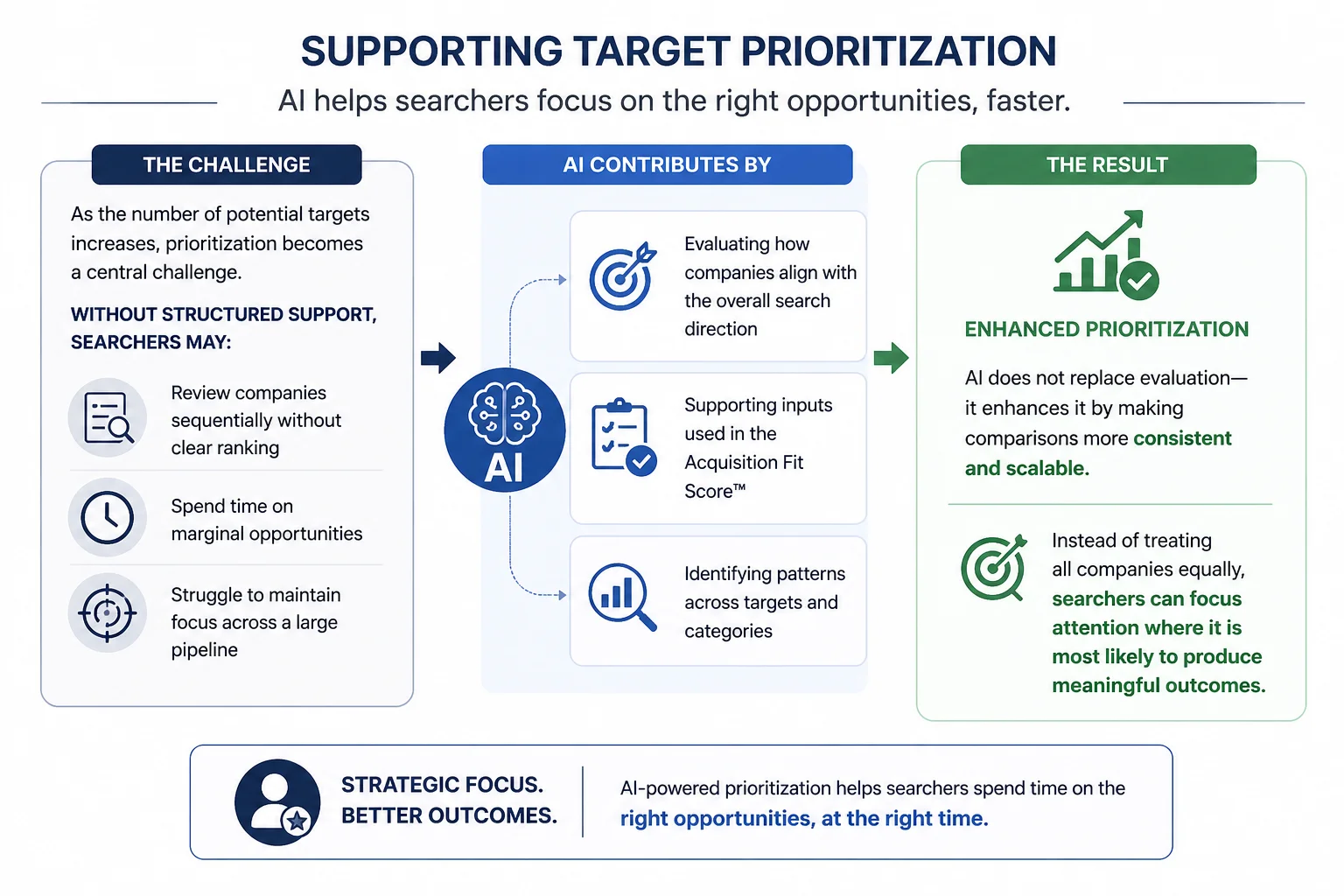
Without structured support, searchers may:
- Review companies sequentially without clear ranking
- Spend time on marginal opportunities
- Struggle to maintain focus across a large pipeline
AI contributes to prioritization by:
- Evaluating how companies align with the overall search direction
- Supporting inputs used in the Acquisition Fit Score™
- Identifying patterns across targets and categories
This does not replace evaluation, but enhances it by making comparisons more consistent and scalable.
Instead of treating all companies equally, searchers can focus attention where it is most likely to produce meaningful outcomes.
Enhancing Outreach Quality
Outreach is another area where execution quality matters more than volume.
Writing, adapting, and managing communication across many targets can quickly become inconsistent, especially over longer time periods.
AI supports outreach by:
- Assisting in drafting personalized, context-aware messages
- Adapting communication to different target profiles
- Supporting structured follow-up sequences
This helps maintain a consistent standard across outreach efforts without requiring the same level of manual input each time.
The goal is not to automate communication entirely, but to:
- Improve clarity and consistency
- Reduce time spent on repetitive writing tasks
- Support a more disciplined outreach process
Increasing Speed Without Losing Control
Speed is important in acquisition search, but not at the expense of control.
AI allows searchers to:
- Process larger datasets more efficiently
- Maintain structured workflows across multiple activities
- Reduce time spent on repetitive operational tasks
At the same time:
- Final decisions remain fully with the searcher
- Judgment, interpretation, and strategy are not automated
- AI acts as support, not a replacement
This balance is critical.
The objective is to move faster with structure, not simply to increase activity.
AI as a Structural Advantage in Search Execution
In Search Fund Plus, “AI-driven” reflects how the platform improves execution across the entire search process.
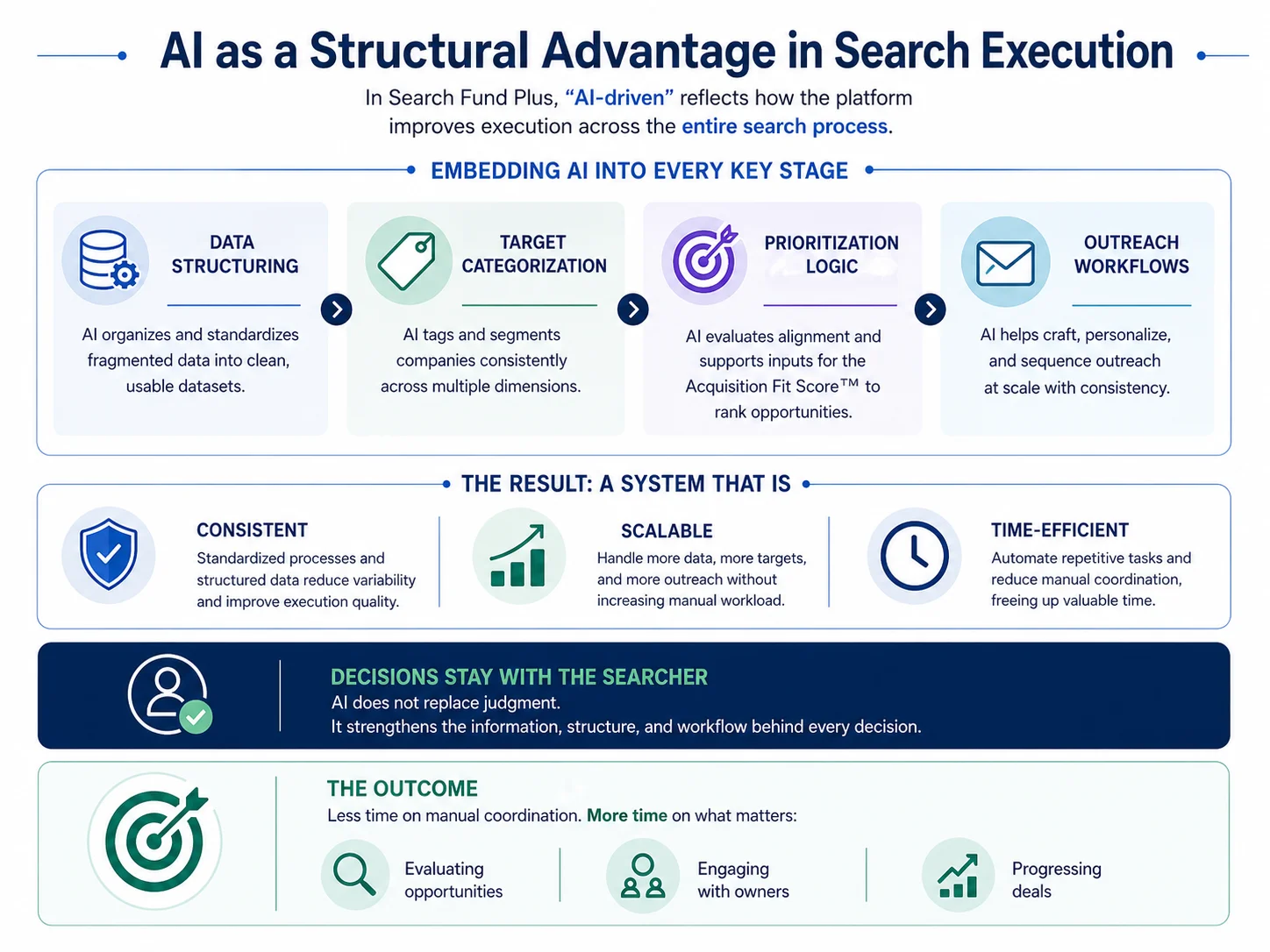
By embedding AI into:
- Data structuring
- Target categorization
- Prioritization logic
- Outreach workflows
it creates a system that is more:
- Consistent
- Scalable
- Time-efficient
Importantly, this does not change who makes decisions, it improves how those decisions are supported.
The result is a search process where less time is spent on manual coordination and more time is focused on evaluating opportunities, engaging with owners, and progressing deals.