

How Does Search Fund Plus Help Prioritize Targets?
One of the most persistent challenges in acquisition search is not access to opportunities, but deciding where to focus.
As the number of potential targets increases, so does the difficulty of maintaining clarity. Without a structured way to prioritize, searchers often find themselves moving between companies without a clear framework, revisiting the same decisions, or allocating time inconsistently across the pipeline.
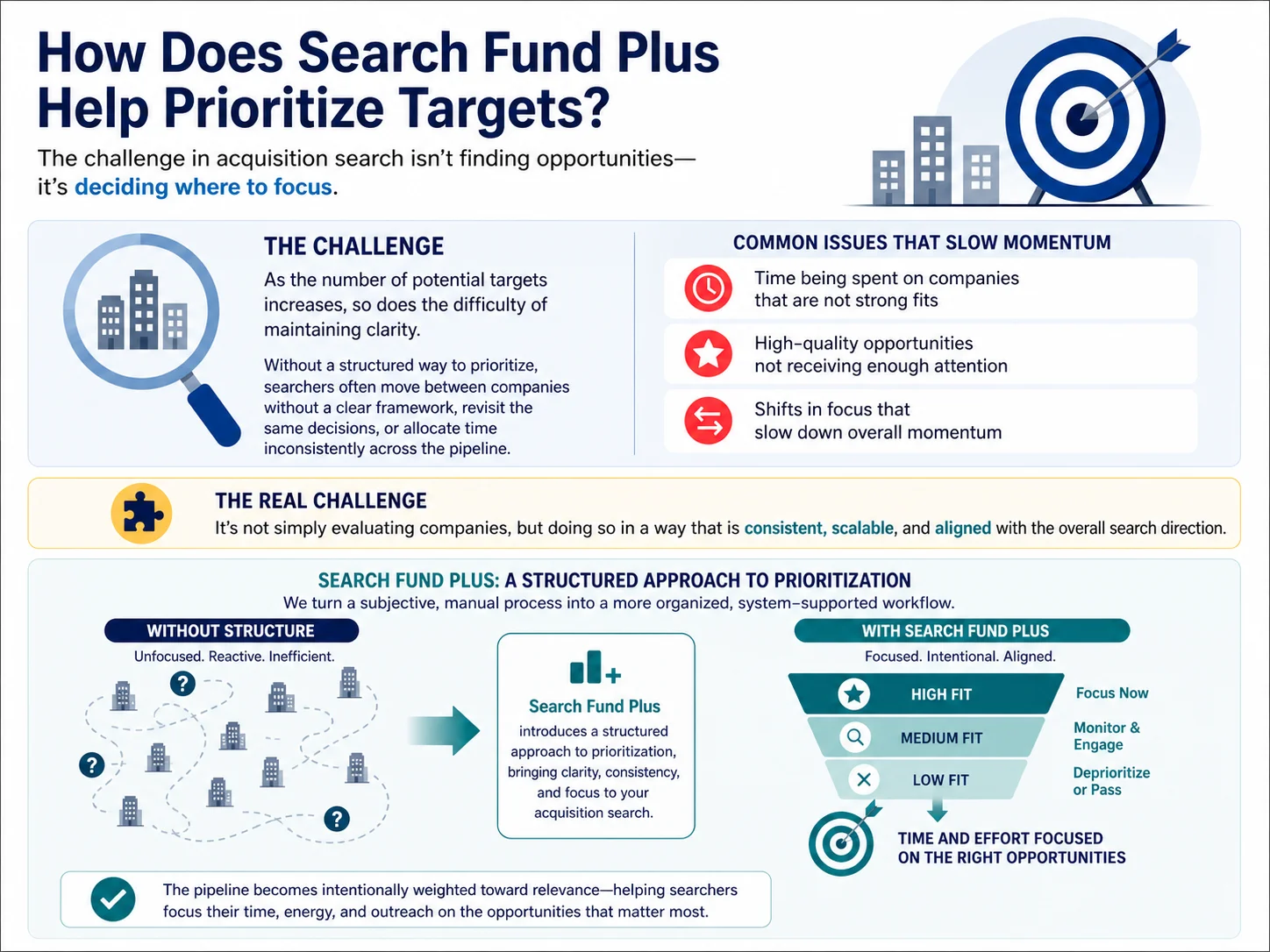
In practice, this leads to a few common issues:
- Time being spent on companies that are not strong fits
- High-quality opportunities not receiving enough attention
- Shifts in focus that slow down overall momentum
The challenge is not simply evaluating companies, but doing so in a way that is consistent, scalable, and aligned with the overall search direction.
Search Fund Plus addresses this by introducing a structured approach to prioritization, turning what is often a subjective and manual process into a more organized and system-supported workflow.
Acquisition Fit Score™ (AFS)
At the center of this approach is the Acquisition Fit Score™ (AFS).
Each company is evaluated in relation to the overall search direction, with AFS acting as a structured way to reflect how closely a target aligns with what the search is trying to achieve.
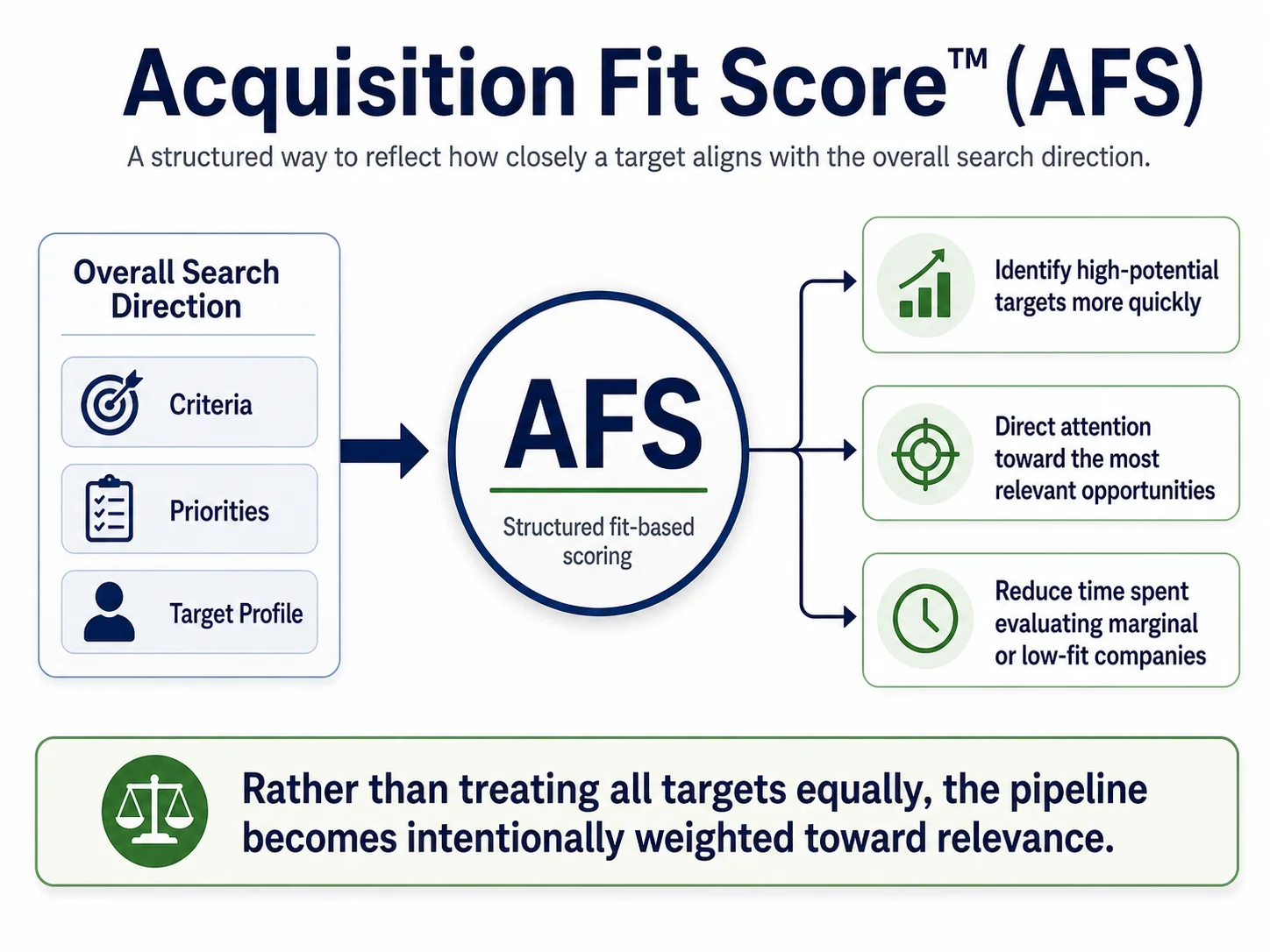
This allows searchers to:
- Identify high-potential targets more quickly
- Direct attention toward the most relevant opportunities
- Reduce time spent evaluating marginal or low-fit companies
Rather than treating all targets equally, the pipeline becomes intentionally weighted toward relevance.
Multi-Dimensional Evaluation
Prioritization in acquisition search cannot rely on a single factor.
Search Fund Plus evaluates companies through a structured, multi-dimensional lens, where different aspects of a business are considered together, not in isolation.
This creates a more complete view of each opportunity, helping searchers:
- Understand relative strengths and trade-offs
- Compare companies more consistently
- Avoid over-weighting any single attribute
The result is a prioritization process that is more balanced and reflective of real-world decision-making.
Tagging and Filtering
Beyond scoring, Search Fund Plus enables searchers to actively structure and navigate their pipeline.
Companies can be:
- Tagged based on relevant attributes
- Filtered dynamically across different criteria
- Segmented into focused subsets
This makes it easier to:
- Isolate specific groups of targets
- Adjust focus as the search evolves
- Navigate large pipelines without losing clarity
Instead of working through a static list, searchers interact with a flexible and structured dataset.
Clear Priority Tiers
To further simplify decision-making, targets are organized into clear priority tiers.
Rather than a flat pipeline, companies are grouped based on their relative importance and timing within the search.
This provides:
- Immediate clarity on where to focus
- A structured way to manage both short-term and longer-term opportunities
- A more intentional allocation of time and outreach effort
From the beginning, the pipeline reflects not just what exists, but what matters most.
Better Focus, Better Outcomes
With structured prioritization in place, the overall search process becomes more focused.
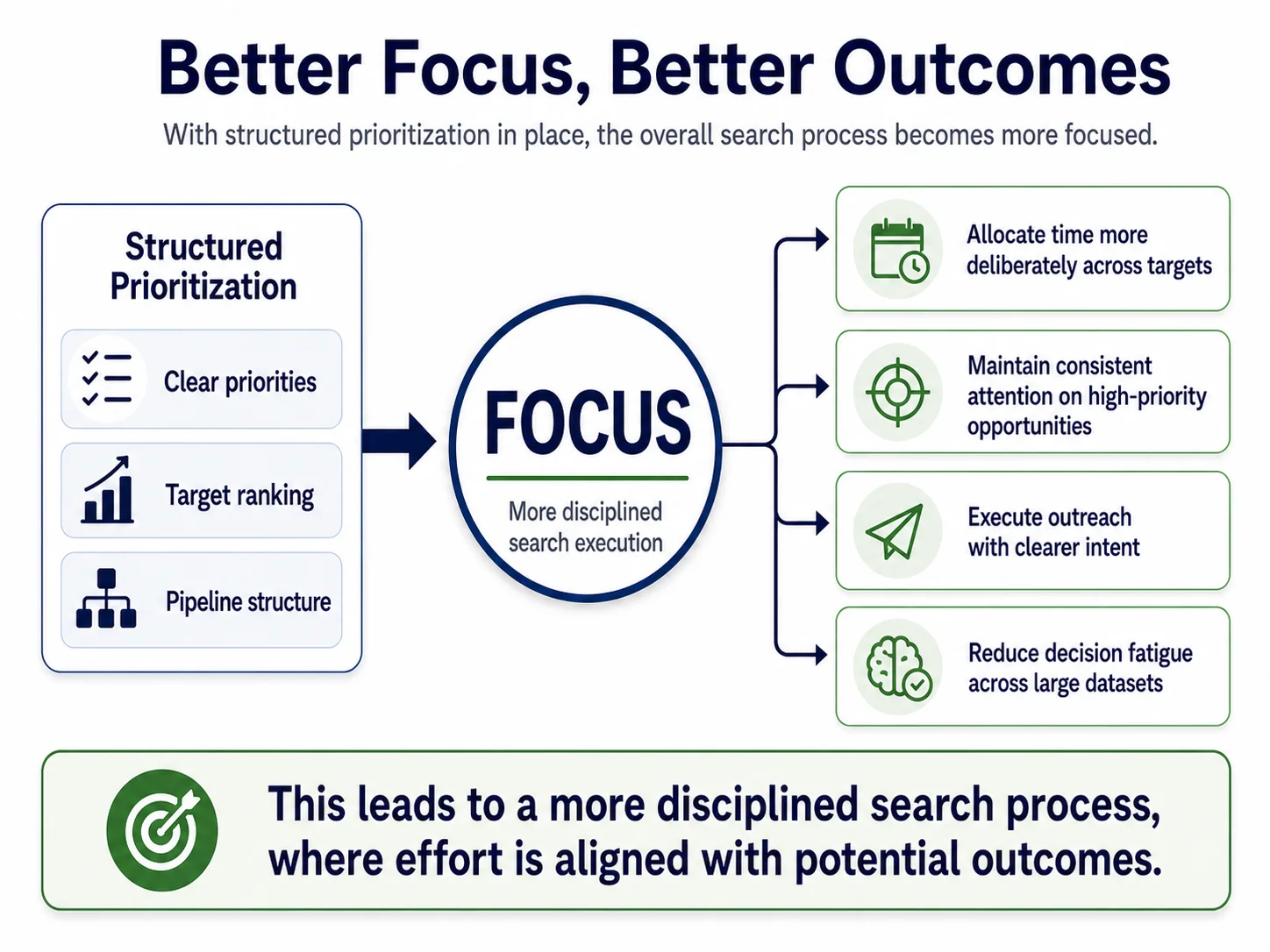
Searchers are able to:
- Allocate time more deliberately across targets
- Maintain consistent attention on high-priority opportunities
- Execute outreach with clearer intent
- Reduce decision fatigue across large datasets
This leads to a more disciplined search process, where effort is aligned with potential outcomes.
Turning Prioritization into a Structured System
Search Fund Plus transforms prioritization from an implicit, often inconsistent activity into a defined and repeatable system.
By combining:
- Structured fit-based scoring (AFS)
- Multi-dimensional evaluation
- Flexible tagging and filtering
- Clear prioritization tiers
it enables searchers to operate with greater clarity and control.
Instead of continuously re-evaluating where to focus, the system provides a stable framework that supports ongoing decision-making.
The result is not just better prioritization, but a more efficient use of time and a stronger ability to concentrate on the opportunities that are most likely to lead to a successful acquisition.