

What Is Driving the Growth of the Search Fund Model?
The search fund model continues to grow because it responds to a real market need: many privately held companies require credible succession solutions, while a growing group of entrepreneurs want a structured path to business ownership through acquisition. At the same time, the ecosystem around search has become more mature. More investors understand the model, more business schools teach entrepreneurship through acquisition, and more research is available to help participants evaluate the path seriously.
This growth is visible in the data. Stanford’s 2024 study covers 681 search funds formed in the United States and Canada since 1984 [1], while IESE’s 2024 international study reports on 320 international search funds formed outside the United States and Canada as of December 31, 2023, with searchers represented across 40 countries and five continents [2]. Together, these studies show that the search fund model has moved beyond a small insider ecosystem and has become a more established path within entrepreneurship through acquisition.
Search Funds Are Expanding Across More Markets
The most direct evidence of growth is the number of new funds being formed and the number of acquisitions being completed. IESE’s 2024 international report, which focuses on search funds outside the United States and Canada, notes that 2023 set a record internationally with 59 new core search funds launched and 31 acquisitions completed [2]. Stanford also notes that 111 new funds were launched outside of the U.S. and Canada across 2022 and 2023, alongside 51 acquisitions during that same period [1]. These are not signs of a static niche. They suggest a model that is spreading across markets and becoming more established over time.
![International Search Fund Activity by Year [2]](https://api-help.searchfundplus.com/uploads/articles/article-1777027167507-829521379.webp)
That growth matters because search funds do not expand through mass-market visibility alone. They tend to grow through repeated examples, institutional learning, and increasing confidence from participants who can now study a more developed body of evidence. As the ecosystem becomes more visible, the barriers to entry become more intellectual and operational rather than purely informational.
Ownership Transition Remains a Structural Tailwind
One of the deepest reasons for continued growth is that many small and medium-sized businesses need succession solutions, and not all of those solutions come from family transfers, strategic buyers, or larger private equity funds. The European Commission notes that successful business transfers can benefit the economy and social fabric by helping maintain economic activity, preserve jobs, and ensure business continuity. It also frames buying an existing company as an alternative to starting a business from scratch, one that can offer certain advantages for buyers [3].
That logic aligns naturally with the search fund model. Stanford describes core search funds as an entrepreneurial path in which one or two individuals form an investment vehicle with a small group of investors to search for, acquire, and lead a privately held company over the medium to long term, typically five to ten years [1]. In other words, the model is not only a financing structure. It is also a succession pathway that can appeal to sellers who care about continuity, stewardship, and long-term operating ownership rather than a purely transactional handoff.
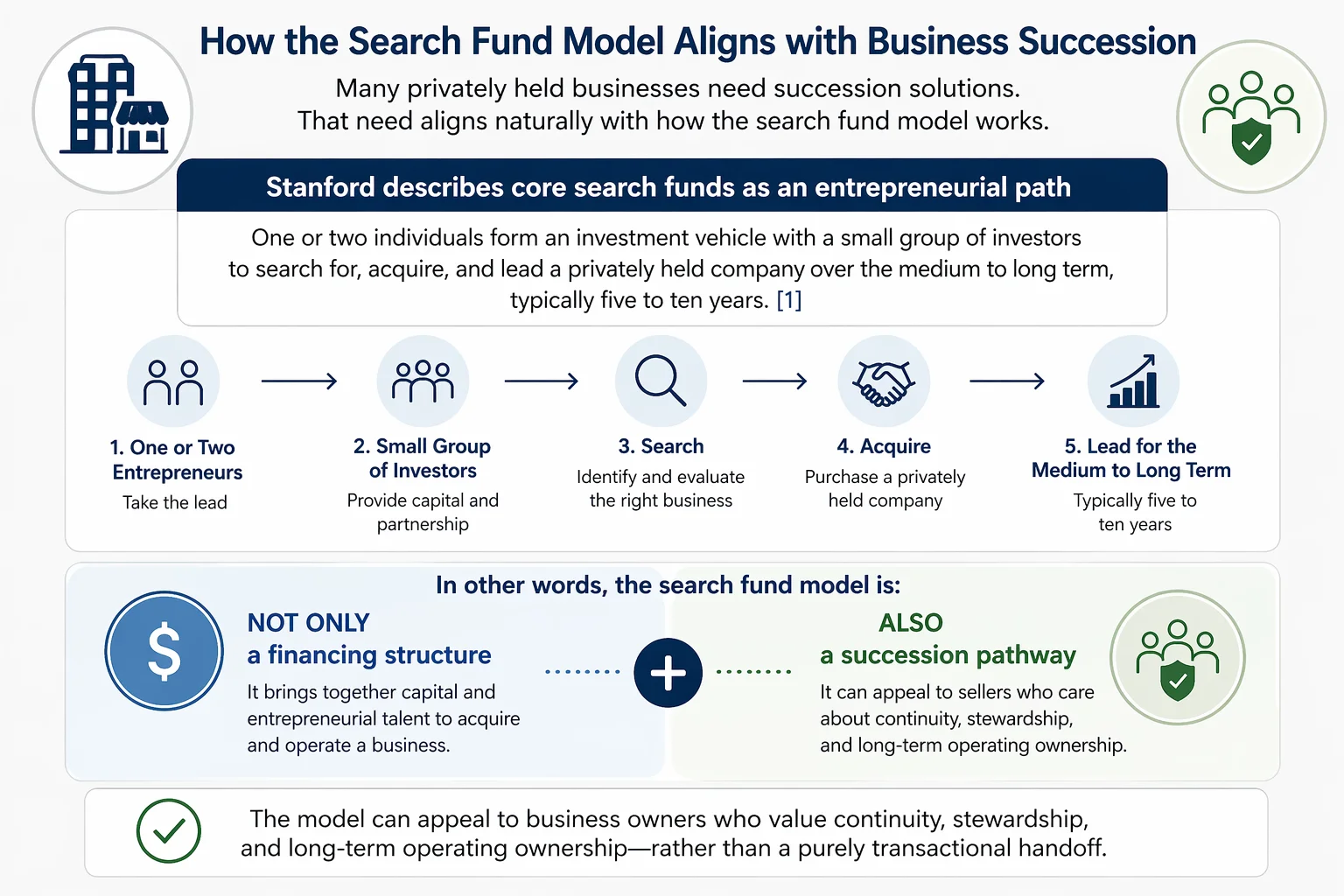
This helps explain why the model continues to resonate. It is not growing only because it offers a path to acquisition. It is growing because it fits a real ownership transition problem in the lower middle market, where succession is often fragmented, personal, and operationally sensitive.
The Model Is Easier to Understand Than It Used to Be
Another reason the model continues to grow is that it is easier to understand than it once was. Stanford has studied search funds in the U.S. and Canada biennially since 1996 [1], and IESE’s International Search Fund Center has tracked international search funds since 2011 in collaboration with Stanford [2]. That continuity matters because it gives both prospective searchers and investors a clearer framework for understanding how the model works, what the lifecycle looks like, and how outcomes have evolved over time.
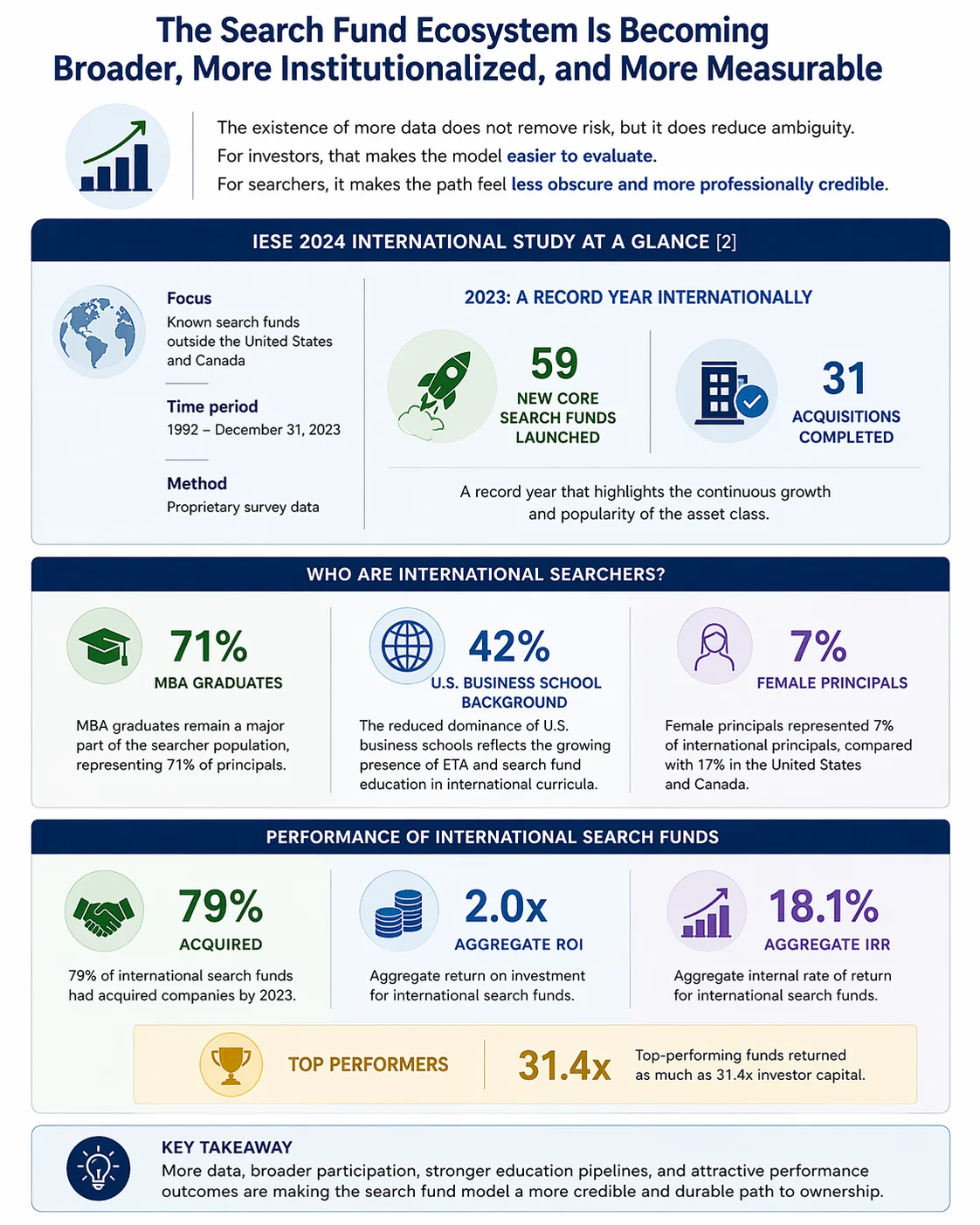
The existence of more data does not remove risk, but it does reduce ambiguity. For investors, that makes the model easier to evaluate. For searchers, it makes the path feel less obscure and more professionally credible. IESE’s 2024 international study shows that the global search fund ecosystem is becoming broader and more institutionalized. Using proprietary survey data on known search funds outside the United States and Canada between 1992 and December 31, 2023, the report identifies 2023 as a record year, with 59 new core search funds launched and 31 acquisitions completed. It also shows that MBA graduates remain a major part of the searcher population, representing 71% of principals, while the reduced dominance of U.S. business schools, at 42%, points to the growing presence of ETA and search fund education in international curricula. The study also reports that female principals represented 7% of international principals, compared with 17% in the United States and Canada. From a performance perspective, 79% of international search funds had acquired companies by 2023, with aggregate returns of 2.0x ROI and 18.1% IRR, and top performers returning up to 31.4x investor capital [2].
Education and Ecosystem Infrastructure Are Expanding the Talent Pipeline
The model is also growing because it is no longer learned only through a small circle of insiders. Business schools and ETA communities now play a visible role in introducing new entrants to entrepreneurship through acquisition. Yale School of Management offered an Entrepreneurship Through Acquisition course in Fall 2024 focused on how to select, purchase, finance, operate, and grow a business [4]. INSEAD’s Entrepreneurship Through Acquisition and Search Funds Hub is designed to support students, alumni, investors, advisors, and board members [5]. IESE is also organizing a Search Fund and Entrepreneurial Acquisitions Bootcamp in June 2026 to guide participants through the full journey of identifying, acquiring, and leading a company [7].
This matters because the model becomes easier to enter when it is supported by education, research, and community infrastructure. People can now study the lifecycle, compare models, hear operator experiences, and understand where search tends to work well and where it tends to break down. That does not make search easy, but it does make it easier to approach seriously.
Dedicated conferences reinforce that pattern. Rotterdam School of Management’s Entrepreneurship Through Acquisition conference is designed to bring together investors, operators, search fund entrepreneurs, MBA students, and alumni around the growing ETA landscape in the Benelux region [6]. That kind of ecosystem infrastructure does not create growth by itself, but it does strengthen visibility, legitimacy, and network density around the model.
Growth Does Not Mean Search Is Easy
It is important not to confuse growth with simplicity. A growing ecosystem does not remove the underlying realities of search: long timelines, failed deals, variable seller readiness, and the challenge of moving from searcher to operator after acquisition. In fact, one reason the model has become more credible is that it is now discussed more openly and more rigorously than before. Better documentation has made the model more visible, but it has also made the difficulty of execution harder to ignore (See example: [1][2].)
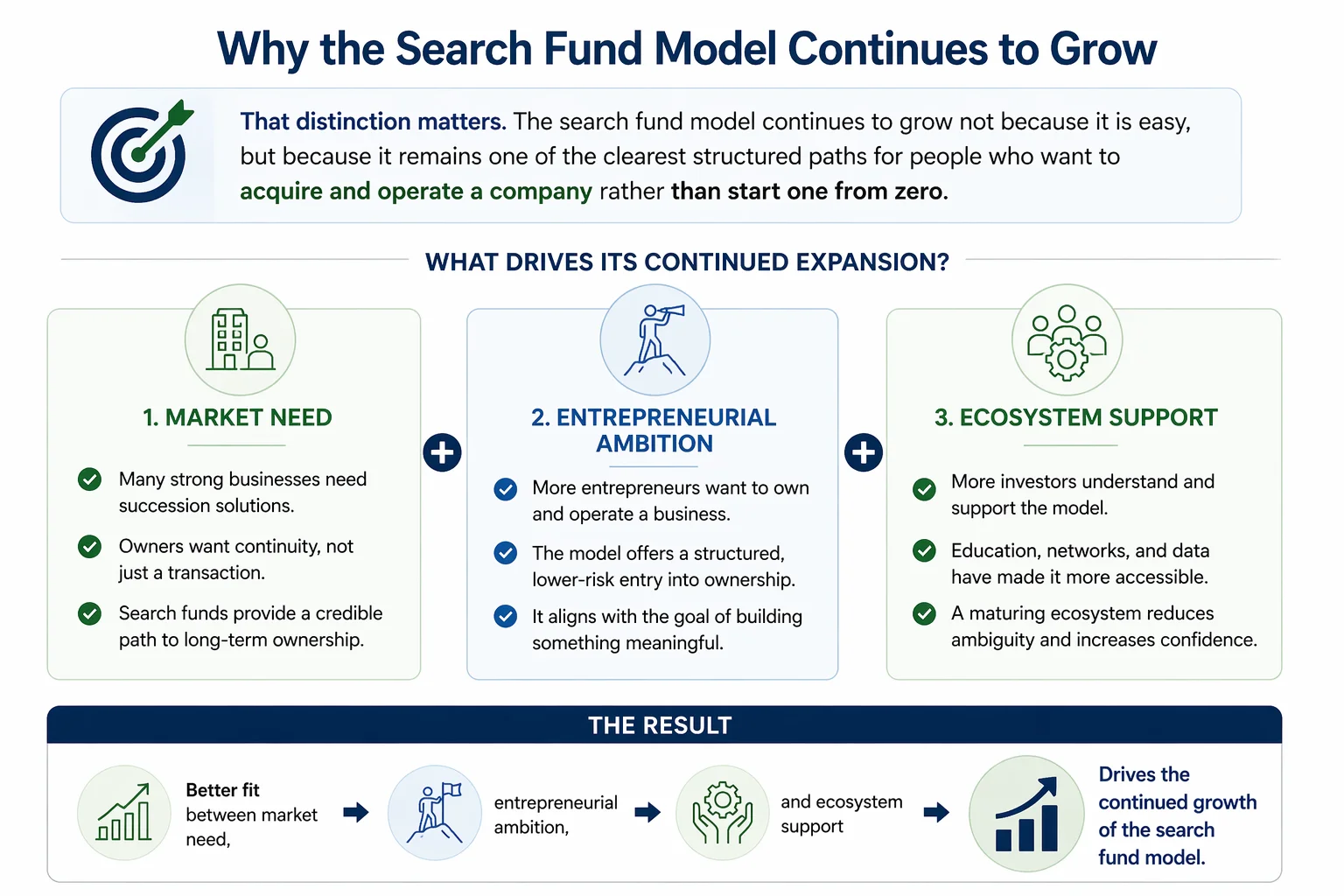
That distinction matters. The search fund model continues to grow not because it is easy, but because it remains one of the clearest structured paths for people who want to acquire and operate a company rather than start one from zero. Its continued expansion reflects a better fit between market need, entrepreneurial ambition, and ecosystem support.
Conclusion
The continued growth of the search fund model is not only about more funds being launched or more acquisitions being completed. It reflects a broader shift in how entrepreneurship, ownership transition, and small business continuity are being understood. Search funds sit in the middle of these forces: they give sellers another path for succession, give entrepreneurs a structured route into ownership, and give investors a clearer way to participate in acquisition-led entrepreneurship.
This does not make search simple. The model still requires discipline, patience, judgment, and the ability to move through uncertainty. But its appeal has become easier to understand. Search funds continue to grow because they respond to a real market need while offering a serious path for capable operators who want to acquire, lead, and build enduring businesses.
Sources
[1] Stanford Graduate School of Business, 2024 Search Fund Study
[2] IESE Business School, International Search Funds 2024
[3] European Commission, Business Transfers
[4] Yale School of Management, Entrepreneurship Through Acquisition, Fall 2024 course syllabus
[5] INSEAD, Entrepreneurship Through Acquisition & Search Funds Hub
[6] Rotterdam School of Management, Entrepreneurship Through Acquisition Conference
[7] IESE Business School, Search Fund and Entrepreneurial Acquisitions Bootcamp
Editorial Note
This article combines directly cited source-based statements, paraphrased material derived from the sources listed above, and editorial synthesis prepared by the SFP team. Where definitions, factual claims, or data points are directly attributable to a source, they are cited accordingly. Other passages reflect analytical reframing, interpretation, and structured commentary based on the same source base. Given the limited number of authoritative sources on certain aspects of this topic, some uncited language may still resemble commonly used formulations in the broader search fund literature, even where the final wording has been independently written or adapted for editorial clarity.