

What Challenges Does Search Fund Plus Help Solve?
Research from leading academic institutions such as Stanford Graduate School of Business, IESE Business School, and Yale School of Management consistently highlights a structural inefficiency in traditional search fund deal sourcing.
While search funds have proven to be a highly effective path to entrepreneurship through acquisition, the underlying sourcing dynamics remain fragmented and difficult to scale.
Brokered vs. Proprietary Deal Sourcing: A Structural Imbalance
Academic research from Stanford GSB shows that approximately 65–75% of search fund acquisitions originate from brokered or intermediary-led processes [1].
At the same time, multiple studies indicate that proprietary deals tend to offer more favorable entry conditions and stronger return potential, primarily due to lower competition and improved pricing dynamics [1][2].
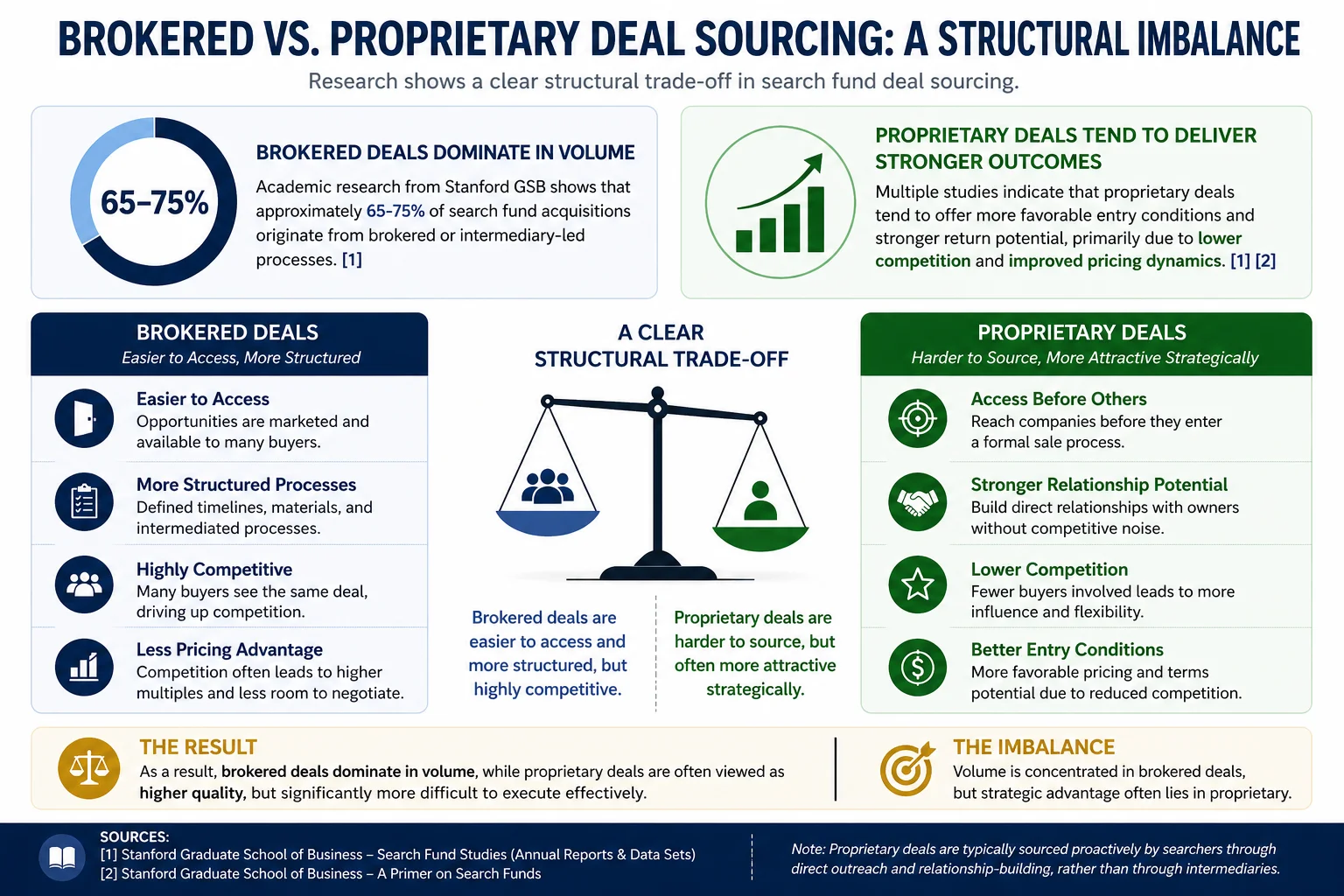
This creates a clear structural trade-off:
- Brokered deals are easier to access and more structured, but highly competitive
- Proprietary deals are harder to source, but often more attractive strategically
As a result, brokered deals dominate in volume, while proprietary deals are often viewed as higher quality, but significantly more difficult to execute effectively.
The Core Challenge: Lack of Infrastructure for Proprietary Sourcing
Despite its importance, proprietary deal sourcing has historically lacked standardized infrastructure.
Searchers have typically been required to independently build:
- Sourcing strategies
- Outreach systems
- CRM and tracking tools
- Data pipelines
- Follow-up workflows
This has made proprietary sourcing highly manual, inconsistent, and dependent on individual experience rather than repeatable systems.
Execution Complexity Beyond Sourcing
Research and practitioner insights from Yale School of Management emphasize that success in proprietary sourcing is not only about generating outreach volume, but also about conversion discipline and execution consistency [3].
In practice:
- Proprietary outreach can generate strong initial response rates
- However, conversion from outreach to closed deals is often significantly lower without structured execution systems
Key challenges include:
- Inconsistent follow-ups
- Fragmented tracking systems
- Lack of prioritization frameworks
- Limited pipeline visibility
How Search Fund Plus Addresses These Challenges
Search Fund Plus is designed to address these structural inefficiencies by providing an integrated system for end-to-end search execution.
Instead of separating sourcing, outreach, and pipeline management, it unifies them into a single structured workflow.
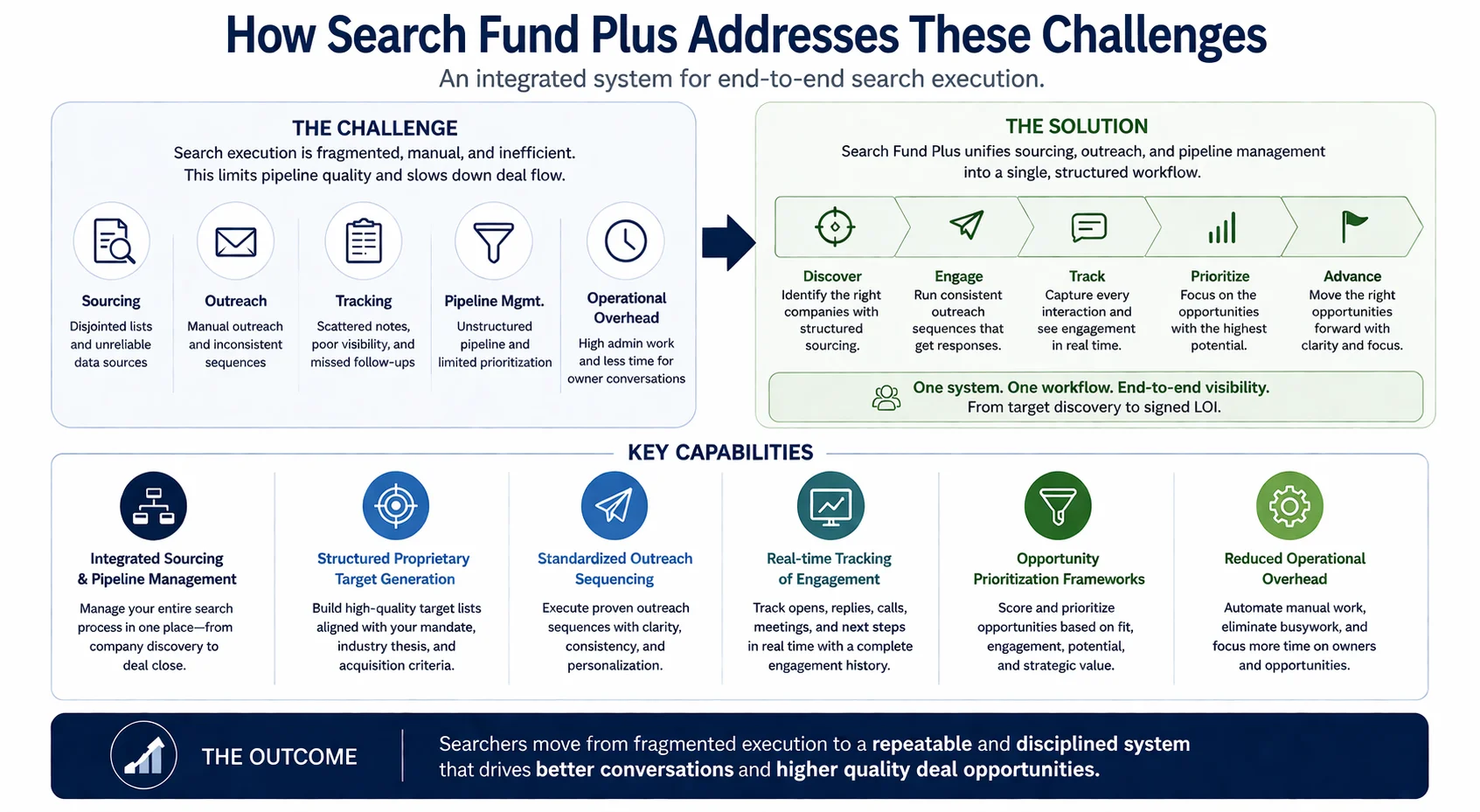
Key capabilities include:
- Integrated sourcing and pipeline management
- Structured proprietary target generation
- Standardized outreach sequencing
- Real-time tracking of engagement
- Opportunity prioritization frameworks
- Reduced operational overhead
This enables searchers to move from fragmented execution to a repeatable and disciplined system.
Maintaining Consistency Over Time
One of the most common challenges in search execution is loss of momentum over time.
Search Fund Plus addresses this through:
- Continuous target generation
- Standardized workflows
- Pipeline visibility and structure
- Reduced administrative burden
This ensures consistent execution across the full lifecycle of a search.
Final Summary
Search fund research consistently shows a structural imbalance between brokered and proprietary deal sourcing: while brokered deals dominate in volume, proprietary deals often offer superior strategic potential but require significantly more infrastructure to execute effectively [1][2].
Search Fund Plus is designed to solve this gap by turning proprietary sourcing from a fragmented, manual process into a structured and repeatable system.
The result is a more disciplined approach to search execution, enabling searchers to spend less time managing complexity and more time identifying, engaging, and closing the right opportunities.
References
[1] Stanford Graduate School of Business – Search Fund Studies (Annual Reports & Data Sets) https://www.gsb.stanford.edu/faculty-research/centers-initiatives/case-entrepreneurship/research/search-funds
[2] Stanford Graduate School of Business – A Primer on Search Funds https://www.gsb.stanford.edu/faculty-research/case-studies/primer-search-funds
[3] Yale School of Management – Search Fund Research Initiative https://som.yale.edu/faculty-research/our-centers-initiatives