

Agriculture, Forestry, Fishing and Hunting industry analysis shows that NAICS 11 remains a large and economically important sector, but one that requires selective underwriting rather than a simple growth thesis. As an essential part of the broader economy, this industry supports food production, resource-based activity, and related supply chains. For buyers, operators, and search funds, the sector can offer resilient demand characteristics, yet the data suggests that performance is uneven across periods and that attractive opportunities are likely to depend on company-specific strengths rather than broad sector expansion.
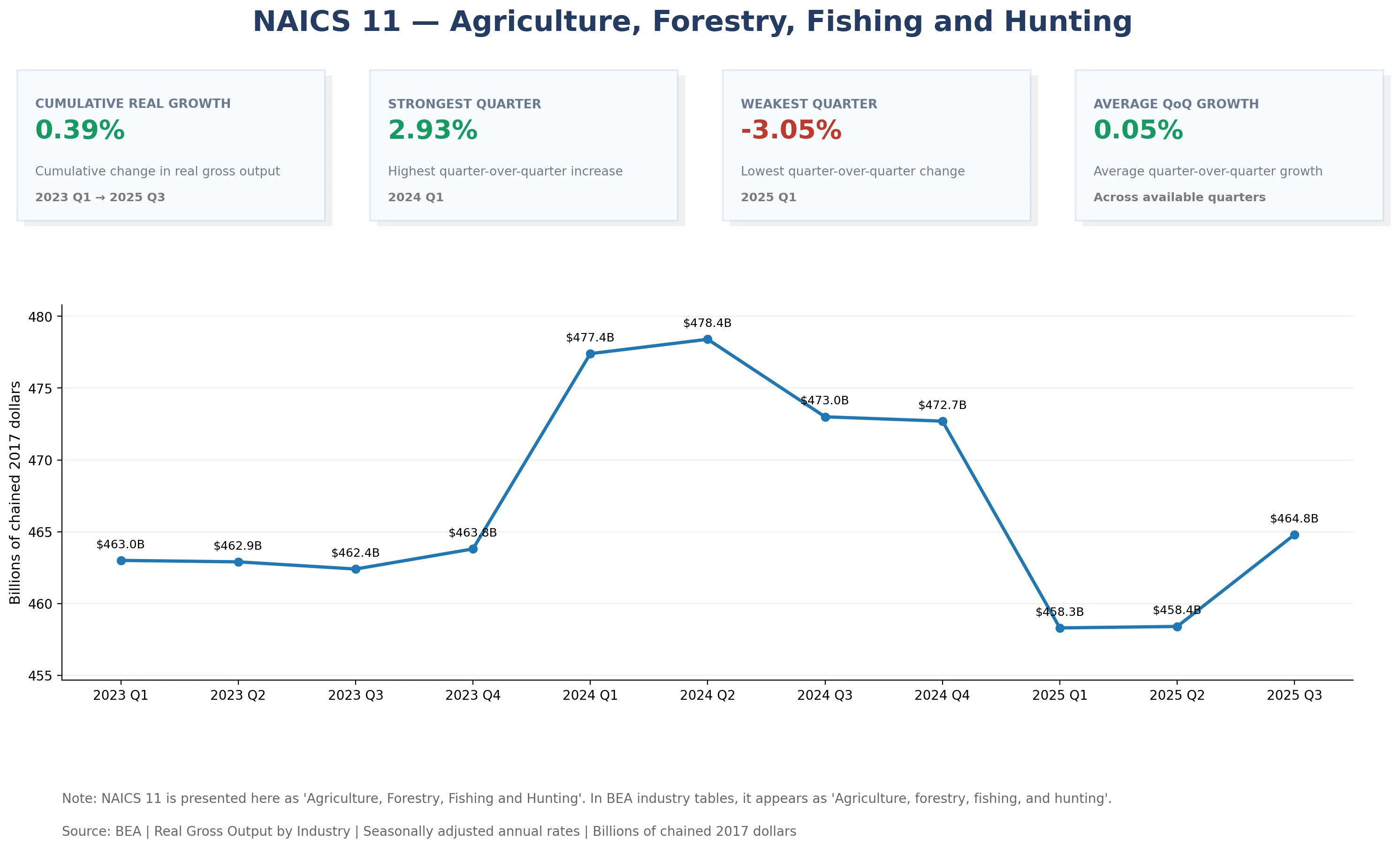
The NAICS 11 real gross output trend is provided above points to a market that has been relatively stable rather than consistently high growth. From 2023 Q1 to 2025 Q3, cumulative real growth was 0.39%, while average quarter-over-quarter growth remained limited at 0.05%. The sector recorded its strongest quarter in 2024 Q1, followed by a notable decline in 2025 Q1 and only a moderate recovery afterward. From a search fund perspective, this indicates that acquisitions in Agriculture, Forestry, Fishing and Hunting may not benefit from strong automatic market tailwinds. Instead, value creation is more likely to come from better operations, pricing discipline, route density, customer retention, and tighter execution.
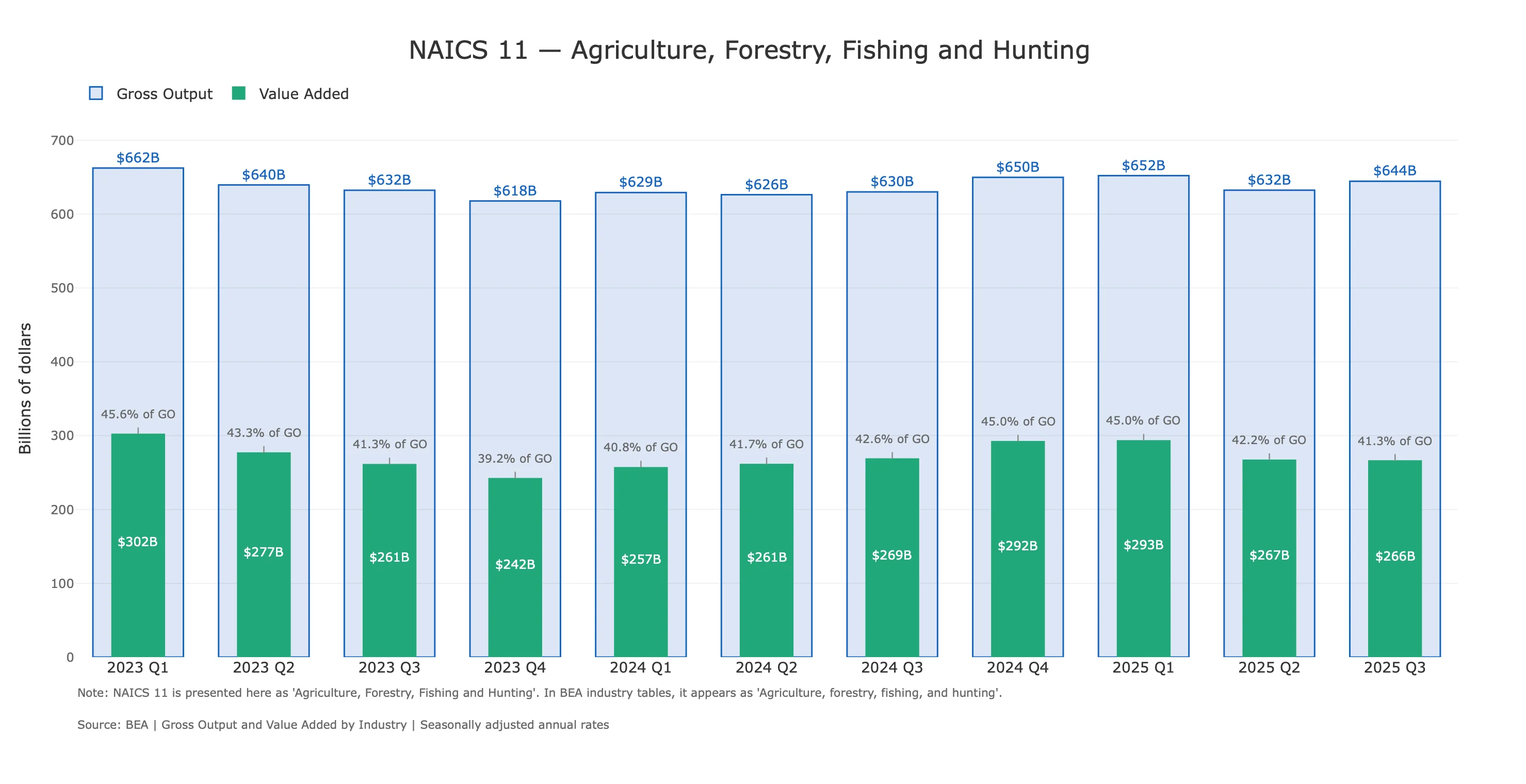
On the other hand, provided the relationship between gross output and value added in NAICS 11 above, gives another important signal for investors evaluating sector quality. Gross output remained within a fairly narrow range, while value added and the value-added share of gross output moved more noticeably across quarters. That variation suggests that not all sector activity converts into equally strong economic value. For search funds and lower middle market buyers, this is a meaningful underwriting consideration. Revenue scale alone should not be treated as proof of business quality. Margin durability, input-cost exposure, labor intensity, and seasonal volatility should all be examined carefully before viewing a target as highly attractive.
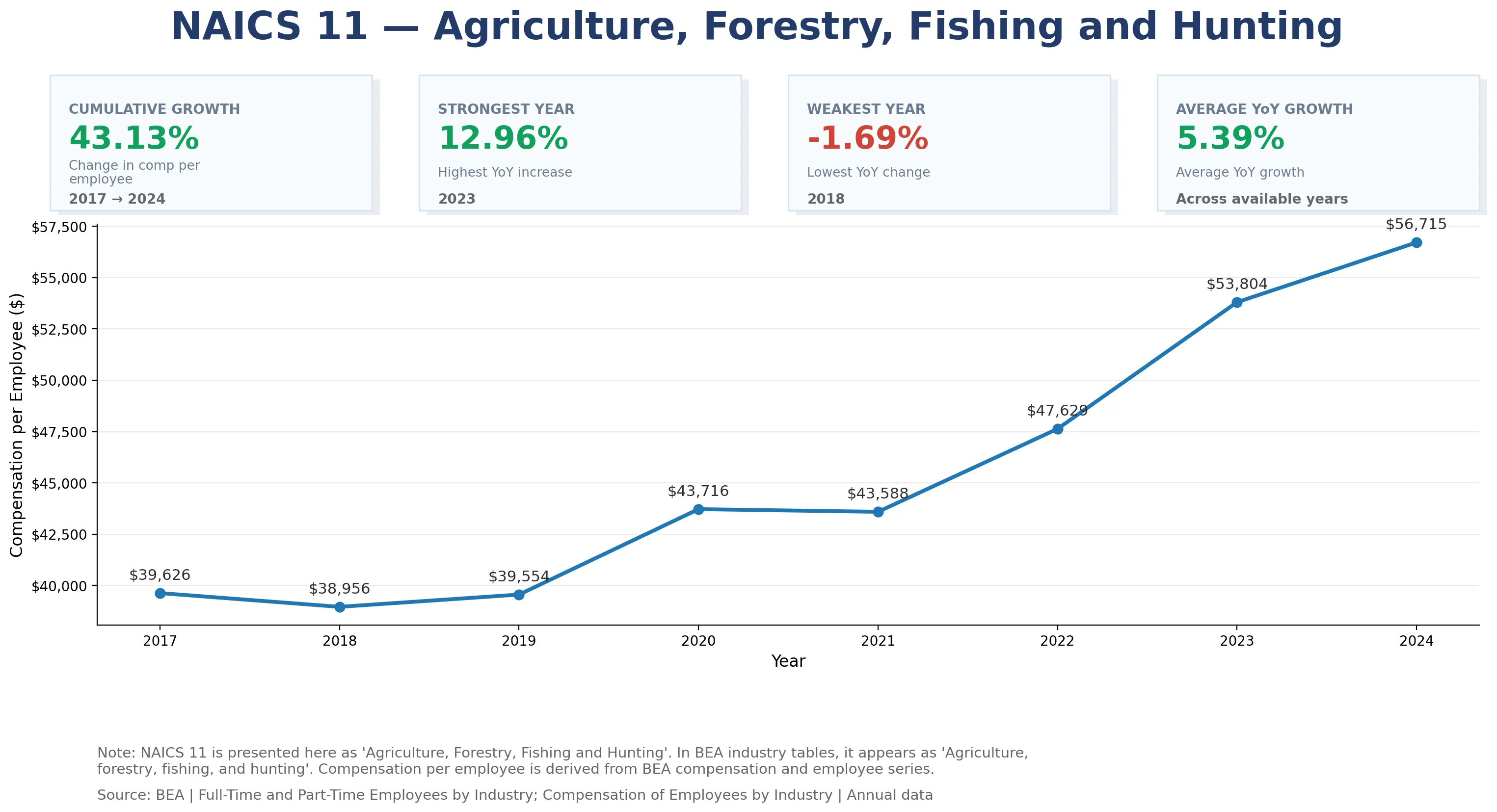
At the same time, the compensation per employee trend in Agriculture, Forestry, Fishing and Hunting indicates meaningful long-term growth. Compensation per employee increased from $39,626 in 2017 to $56,715 in 2024, reflecting a cumulative increase of 43.13%. This can support a more positive interpretation if the rise is driven by productivity gains, specialization, or stronger pricing power in certain parts of the sector. However, it can also point to wage pressure that less efficient businesses may struggle to absorb.